

This post is a guest blog by Financial Coach and Writer Clare Seal.

Most financial advice and information makes certain assumptions about the ways we live and earn: 9-5 hours, consistent monthly salary, employed role. But what happens when your financial circumstances don’t quite fit the mould?
For most of our working lives, either my husband or I have worked outside of that blueprint – from being paid hourly and topping up our income with tips when we worked in hospitality, to now, being self-employed with an inconsistent income.
Trying to budget according to the usual monthly model, with no adjustments for how we worked and got paid felt like trying to fit a square peg into a round hole.
It just didn’t work for us, and would leave us feeling frustrated, often with a financial shortfall. Eventually, we worked out some tricks to manage our money better according to our own lifestyle:
When you work for an hourly wage or do a lot of overtime, it can mean that you don’t take home the same amount each month. Thanks to tax thresholds, it can be difficult to figure out exactly how much money will be entering your account, which makes budgeting a bit of a nightmare.
To make this easier, you can calculate your ‘bottom line budget’ – the absolutely minimum amount that you need each month to cover the essentials and keep things ticking over. This might mean being more agile with things like streaming subscriptions, turning them on and off according to your income, or choosing more flexible models for some of your bills.
When your income is irregular, you sometimes need to be a bit more hands-on with smoothing it out – it’s more difficult just to let things tick along. Having a fund to dip into so that you can top up your income during leaner months is a really good place to start.
You can also create designated sinking funds for specific things like your MOT, Christmas, birthdays, school holidays and more. These are little pots of money that you save into across the year, to avoid big financial shocks when they arise.
When you earn or work variably, zooming out and looking at the bigger picture is often really helpful. Take into account seasonal work increases or decreases, or even gaps in your income caused by factors like school summer holidays, and work out where your capacity to save is higher or lower.
There are various ways to do this, and the right way for you will depend on a few things – the type of variation in your work or whether you prefer digital or paper tracking methods, for example. It can even be helpful to use both: a paper calendar to keep things easily visible, paired with a spreadsheet for calculations and insights.
A budgeting app can help you to analyse your income and spending, so that you can easily see when these increase or decrease and figure out how much you should be putting aside when the cash is flowing more, plus how much you’ll need to top up during leaner periods.
From child benefit and free childcare hours to universal credit, lots of benefits go unclaimed because people aren’t sure whether or not they are eligible. You can check your eligibility for most things through the government website, but there are also great organisations like Income Max, which can help you to find support that you might not have claimed yet.
It’s also a really good idea to check your payslip and tax code frequently, in case any mistakes mean that you are missing out or are due a rebate.

Most workplaces have untapped resources available to team members, so make sure you’re clued up on what’s available. From help-to-save schemes and wage streaming to discount platforms like Blue Light Card, there could be multiple avenues for making things cheaper and easier for yourself.
You can also make sure that you opt in to things like your workplace pension, if you aren’t consistently working or earning enough to be auto-enrolled.
This is just as important as looking after your finances. Budgeting an unconventional income can be stressful and anxiety-inducing, and having to chip into savings or borrow money to make it through tight months can take a toll on your mental health.
Make sure you check in with yourself and talk to somebody if it all feels a bit too much. There’s nothing wrong with admitting that you need help or support, and sometimes talking it through can take a weight off your shoulders.
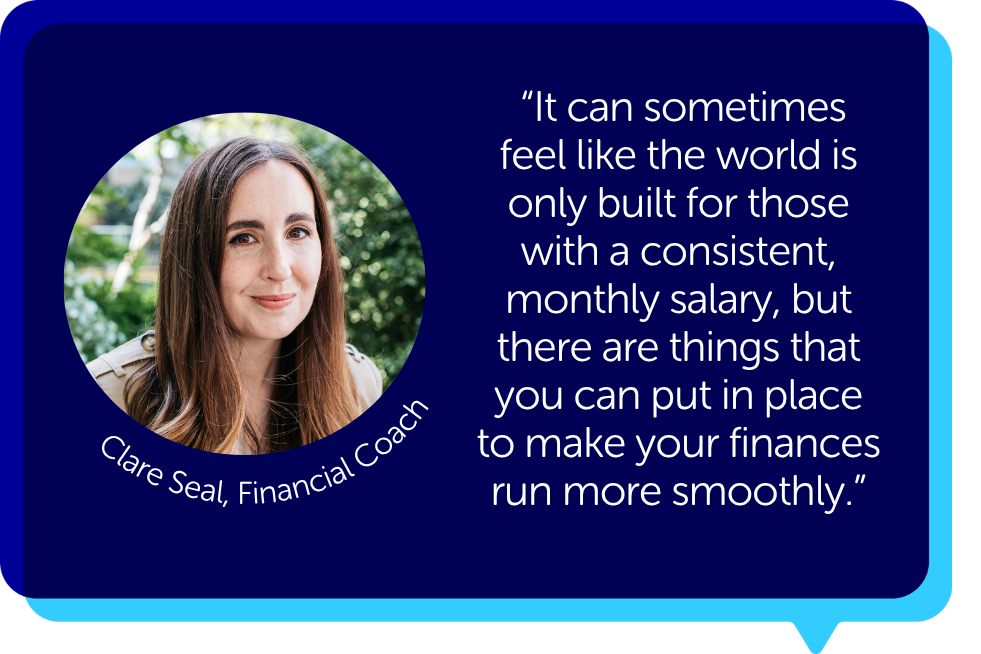
It can sometimes feel like the world is only built for those with a consistent, monthly salary, but there are things that you can put in place to make your finances run more smoothly and reduce your stress.
Hopefully, tips like these will help you to find your own way with money, and recognise that it’s ok to do things differently according to what works best for you and your life.